Showing posts with label History. Show all posts

Saturday, 8 August 2015

Water, Stones & Secret Agents


La Ruta de la Piedra y del Agua - the route of stone and water - is most certainly one of the most beautiful walks I've ever had, on the Camino or elsewhere. The first part is an unspoiled wilderness, a wild stream with lots of small old watermills, weathered, covered in green, most of them without a roof, but with the millstones still there. The path is green to, and part of it all.

Ingenious ways were found to create waterchutes to power the mills with water.

After a few kilometers downstream there is more civilization; a newer path, lit in the evening, a cafe, a parking place, mountain bikers on the path again. A somewhat threatening sign announces that the European Union supports restoration.Hopefully the balance between conservation and leaving things as they where for many centuries will be held.

A wonderful walk of 7,5 kilometers that ended on this particular day on a terrace with a special guest. There was some unusual activity- military motorbikes, lots of police. Joggers who weren’t joggers, these big guys talking into earphones. It turned out that the Spanish prime minister, Mariano Rajoy had also been enjoying some of the mills, and was having a drink now at the table next to me. Pontevedra is his home area. Nice guy, gave a very friendly greeting when he left. 

This Ruta is part of the Variante Espiritual, a new alternative for the Portuguese way between Pontevedra and Padron. Two wonderful, quiet walking days. Especially the second with the above part and a path along the Arousa river, is great. There are two municipal albergues with very nice and cooperative hospitaleros. Last year only 400 people walked this Variante. The last day can be done as a boat trip. Further details, information and background:  Variante Espiritual

Ria de Arousa


Wednesday, 5 August 2015

Treasures of the Camino in Iria Flavia


An old abandoned house next to the church. The door was open. Inside, amongst  the mess... a pile of religious magazines. The oldest one I found was printed in Madrid in 1899. Nice discovery in Iria Flavia, where everything seems to be old, and yet older.


Made a sketch of the grave of Camilo Jose Cela, the famous Galician writer, born in Padron.


He is buried near the church Santa Maria de Iria, surrounded by old tombstones. It also preserves a necropolis of the Suevi (6th Century AD).


Sunday, 7 June 2015

Ermita de San Miguel Arcangel

It's 'treasures' lead a boring life in a museum in Pamplona. The real treasure cannot be taken away from this place. This little chapel or ermita is about a 100 metres from the Camino (between Lorca and Estella) and therefore visited by few. The empty space inside is so stuffed with silence.


Hey, and...there definitely must be a good spirit in this chapel. We had a break there, and I was the last one who left. After a hundred metres I got the feeling something whas missing. So I walked back, and under the table where we lunched was my wallet. Fell out of my pack and I hadn't seen it.

Tuesday, 2 June 2015

La Grande Dame del Camino


The mayor cities along the Camino Frances all have their own character. You will walk through Pamplona, Logrono, Burgos, Leon towards Santiago. I'd say Burgos is the Grande Dame.  

Old. Wealthy, but not to fancy. Well-maintained. Renewed with respect for the history. Well-organized (a really car free towncentre, not theoretically traffic free like in many Spanish cities). Still a lot of old shops present and alive. Not the noisy traffic of megatowns like Barcelona. The cathedral is about Santiago's equal, although very different in character and style. The church is very present in this town. So is a vivid modern streetlife. A good town to stay, Burgos.


San Lesmes, the quiet (and free!) alternative for the cathedral. It's on the Camino.


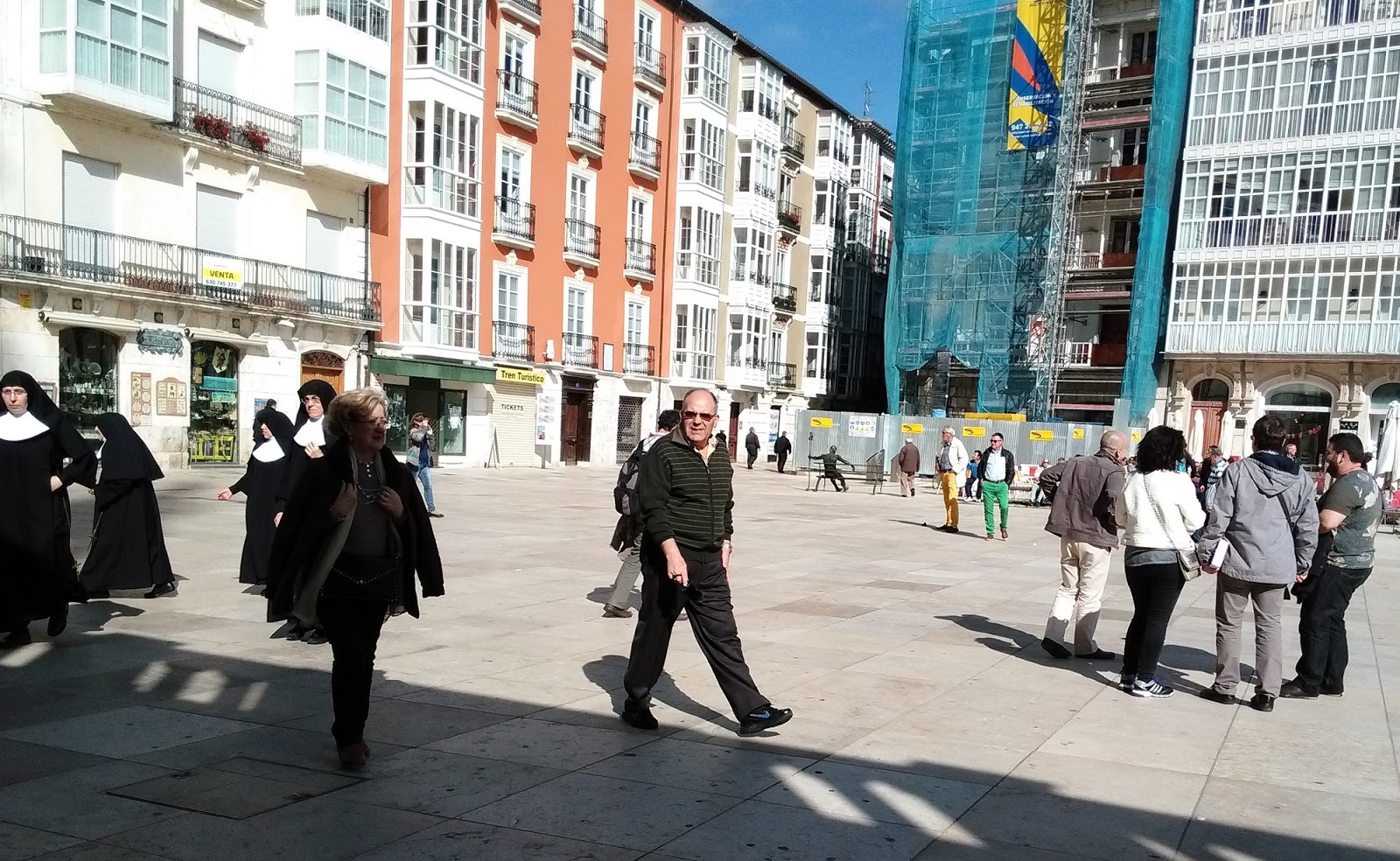
A La Villa de Madrid is a lovely old shop selling thousands of religious articles. The owner paints a lot of articles herself, in the shop. When I was there a nun came in. The row of costumers suddenly vanished and she was being served first.


Pilgrims hospital, founded in 1466


Sunday, 10 August 2014

Via de la Plata 2014/ Monasterio de Oseira


It reminds me vaguely of the entrance to Santiago.. discovering the tower of the monastery for the first time. The stage before Oseira is one of the most quiet and silent of any Camino. No houses, no cars. Lovely hours through woods and on silent roads. Although there was no clear sight at all because of the rain. But impressive it is, the first view of the complex of the Monasterio de Oseira. It is a remote place. Around the monastery a few houses and two bars. Wooded slopes. In daytime there are visitors, at night it is silent. 

In an immense annex is the albergue. A beautiful old dormitory run by a dedicated Flemish volunteer,  who stays here every summer, supporting the monks. He's a real Via de la Plata veteran.


The lifeline of the monastery and therefore one of the main reasons to establish it here: plenty of clean, bright water. Old washing stones along the steps of the bridge. 


The guided tour in the monastery (four times a day) is very special. The architecture is splendid. Oseira is a lovely place to stay. 

Thursday, 7 August 2014

Via de la Plata/ the roads of Spain


Centuries of transport in one photo. Seen from the modern motorway is first the medieval bridge. Then the highspeed train Santiago-Barcelona. Far behind it the 19th Century railroad bridge(see photos below). Donkeys carried stones from the river bed up to build the bridge.


the medieval bridge


A centuries old path, laid by hand. For men and oxes.

Saturday, 13 October 2012

Gamaschen and other language matters

I threw away my gamaschen just a few days before the rains started. First I carried them along for 600 kilometers through Spain. Gamaschen -  do you know what I'm talking about? I've always loved this word, but the sound is strange to. Now I found this word is of Arabian origin! Which makes the connection of this subject to the Camino possible: many, many words in European languages found their origin in Arabic. And Islamic Spain is the most important source of this. Quite common words like coffee, spinach, alcohol, admiral, albatros, cheque, soda. And orange.
Al-Andalus is the beautiful and mystic name of the wealthy kalifat in Southern Spain, that brought us so many treasures in knowledge, arts, architecture and so on. The Moors reigned there for many centuries, and the Reconquista (conquering back the land on the Islamic invaders) dominated Spanish history for centuries. 
Back to the gamaschen: it was originally a kind of 'overshoe' , worn to protect stockings. And
they were made of leather. Through French and the Provencal language we borrowed the word from the Spanish guadameci (a soft kind of leather). This was taken over again from the Arabic (djild) ghadamisi- leather from the town of Gadames in Lybia. The gamaschen were worn a lot until the 17. Century. Later the word wasn't used anymore, but came back from German since mountain- and snowsports came up. Nowadays you wear them to protect your shoes from getting soaked in rain or snow.

And, yes indeed, you may need gamaschen on the Camino. You could pick up mine in one of the Galician albergues.

Source: Koffie, kaffer en katoen. Arabische leenwoorden in het Nederlands, written by Marlies Philippa.

Saturday, 6 October 2012

History of the Camino and Pilgrimage

"When we first trekked to Compostela in 1974 we did not meet even one other pilgrim on the Road."
Isn't that a very promising start for a book about the Camino*.
I was in Galicia myself in 1992, and walked from Sarria backwards to the monastery of Samos. Don't remember having met any other people on the road. And...I could just touch the famous statue in the cathedral...
In 1986 2.500 people walked the Camino, in 1996 23.000, in 2006 about 100.000 (and even more in the roman catholic Holy Years, like 1999 and 2004). So the growth went very fast!
A way to describe Pilgrimage is 'leaving ordinary life to seek for mental health.' It might have a religious meaning, but that's not a condition of course. Making a pilgrimage journey is an essential character of all world religions. Goethe wrote in the 18. Century that the camino (he meant all pilgrimsways) made Europe for what it is.
Since the end of the 20. Century there is a great revival in Pilgrimage, and the Camino de Santiago is the most important representative of this phenomenon. But the roots are old, very old.

It is so fascinating to realize that in some periods of European history more than ten percent of the European male population was involved in pilgrimage. As a pilgrim, of course, but also in the large trade it attracted. Some of the pilgrims were female.
Not everybody was always in a spiritual mood: prostitution florished along the Camino, too.
The numerous hospitiums you will notice along the Camino symbolize how hard travelling has been in the Middle Ages. Of course, a lot of people went on a pilgrimage already ill, because they sought for cure by doing this. But also lots of pilgrims were robbed and beaten up along the Camino.
Most people were travelling for one or two years. And most of the time they had to walk back, to.


So you will step into a rich and ancient heritage on the road.


* The pilgrimage road to Santiago, by David Gitlitz and Linda Kay Davidson.
Another source is: Pelgrimage. Een spirituele reis (Pilgrimage. A spiritual and Cultural Journey) by Ian Bradley (2009). Not entirely my kind of book, but it contains some very interesting ideas and facts.


impressions: San Felix de Oca


Such a special, quiet place to dream away about the past. The remnants of a monastery, built in between the 7. and 9. Century. Imagine those times...

I looked through the window on the right side. I felt the cold air inside, where no sun ever comes in. A sense of the 1.400 years that have passed by. I'm 51, my son is 19.


Tuesday, 25 September 2012

La Cañada Real Leonesa Occidental


A real great moment for me on the Camino was crossing the Cañada Real Leonesa Occidental on the 25. September. Very harsh winds all day, so me and my companions didn't stay there very long.
The Cañadas and the Mesta are a very special part of Spanish history.
It's all about sheep. And I love sheep. Just read the next message.


Transhumance is the centuries old tradition of bringing the herds from summer- to winter pastures, depending on the season. Nowadays the transport takes place by truck or train, but it used to be a walking thing. The herds needed space to travel slowly, and that is why there are cañadas, broad grasscovered ways (up to 75 meters) in a huge network through Spain.
Spain was divided between Moors and Christians for centuries. In the nomansland in between the rivalling parties only shepherds could be found. It led to a lot of conflicts between farmers and shepherds after the Reconquista. The Mesta was the organisation that guarded the interests of the sheep and wool trade.
Spain's economy was based on wool for a long time. It was delivered to the clothing industry in Flanders and England. A lot ot wealth came from the wool (this is before the time of the colonies and the silver fleets...).
The Honrado Concejo de la Mesta was one of the most powerful institutions in the land. The members came from the nobility and church orders.

The herds (of up to 40.000 sheep!) travelled from Extremadura and Andalusia to Castilia, for instance. This particular route is 700 kilometers long. The cañadas reales were protected by the king and the herds were granted the right to travel there forever.  Nobody could build anything on these routes.

Historians claim that the transhumance network has highly contributed to the unity of the Spanish language. Without this network that lead to a lot of 'interlocal' contact Spain would have had much stronger regional dialects, developing to different languages.


The Cañada Real Leonesa Occidental


Spanish shepherds protesting in Madrid against violation of their rights


The large network of Cañadas all over Spain.
Doubleclick on the image to enlarge it

Wednesday, 19 September 2012

impressions: Fuente de los Moros


Another very special monument on the Camino is this very old water basin. Why this construction? Water level and keeping the water cool, I guess. I just sat here a while, not to drink water but drink in the ancient atmosphere.

Gitlitz writes: Just before Villamayor is a gothic fountain/ cistern. It was restored in 1991. As the name implies, local legends holds that it is a much earlier Islamic construction.
(Gitlitz and Davidson, The Pilgrimage Road to Santiago)